A threshold rather than a return
Open Your Eyes to Another Reality reappears in 2026 with a force that depends less on the novelty of its images than on their ability to return. The work was created and fixed on October 16, 2018. Its renewed video form does not erase that first date. It keeps it visible within a new circulation. Between the two moments, the drawings remain the same anchors, but their function changes. They move from a memory of creation into a public sequence organized for the present.
That shift gives the title a precise meaning. Opening the eyes does not simply mean looking harder. It means accepting that the same visual matter can produce another reality when its relations, rhythm and context change. The video becomes a threshold. It does not lead to a world detached from the first one. It makes another organization of what was already there perceptible.
This logic is central to the work’s continuity. Time does not cancel the first formulation. It adds another surface of appearance. The 2026 return does not replace 2018. It places the two dates in tension and turns their distance into editorial matter.
Seeing through transformation
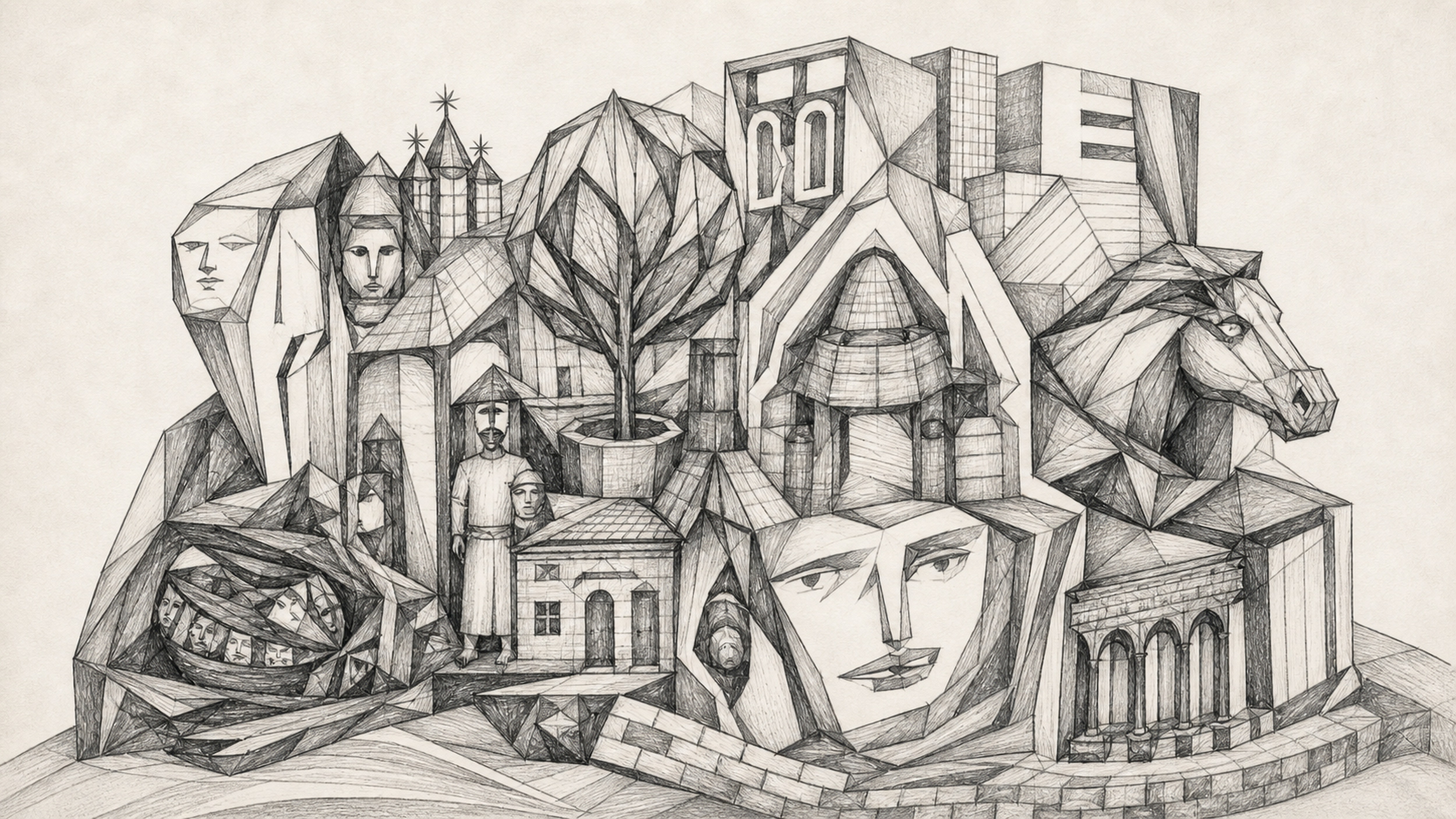
The drawings rely on a discipline of line, contour, shadow and repetition. Architecture, faces, natural forms and symbolic bodies can occupy the same plane without keeping fixed roles. A face becomes a wall. A house becomes a head. A horse joins a city. A tree rises between built masses. These encounters do more than create visual strangeness. They shift the boundaries between figure and environment.
The vision proposed by the work emerges through these passages. Each form remains recognizable long enough for its transformation to register. The house retains something of habitation when it becomes a head. The face keeps a human presence as it approaches architecture. The city remains a city when an animal enters it. The other reality announced by the title therefore does not require the disappearance of ordinary reality. It appears when ordinary categories stop being sealed off from one another.
Drawing makes this principle especially clear. A line can divide, but it can also connect. A contour can close a form, but it can become the shared boundary of two visual identities. Shadow can deepen volume while making a figure less stable. Repetition can establish a motif and then move it toward another reading. Visual matter keeps enough structure to be recognized and enough mobility to change status.
Matter as memory
From 2018 onward, the artistic experience was conceived as a connection among multiple universes through nature and matter. The creation was to be fixed in this world so that it could remain there. The idea of fixation might suggest immobility. The work demonstrates the opposite. What has been fixed can return, be edited again, be placed inside another architecture of visibility and generate a new relation to time.
Visual memory is therefore not presented as a neutral deposit. It acts through forms that persist. Masks, bodies, houses, towers and animal figures are not merely preserved. Their presence becomes available for a new sequence. Memory lies in that availability. It allows an image to remain attached to its origin while entering another temporality.
This tension gives matter a role broader than that of support. Matter records a gesture and gives it continuity. Line, drawn form and their conversion into video movement participate in the same decision to maintain. That maintenance is not exact repetition. It becomes a capacity for reactivation.
The work can therefore be read as an experiment in persistence. An image does not survive only because it is stored. It survives because it can still be seen, edited with other images, placed before a public and introduced again into a present organization.
The archive becomes public
The 2026 renewal changes above all the visibility of the whole. The drawings leave the exclusive memory of the studio and enter a sequence accessible through a contemporary publication. This change does not necessarily add new motifs. It transforms the way existing motifs are encountered.
The archive therefore acquires an active function. It no longer sits only behind the work as a trace of its past. It enters the form of presentation itself. The passage between 2018 and 2026 becomes legible through the coexistence of the initial creation, its memory and its renewed circulation.
This operation also gives concrete meaning to continuity within LXKeys. Earlier work is not isolated as a closed object. It joins a public architecture where image, memory, author and position within the ecosystem can respond to one another. Publication becomes less a final destination than a point of connection among several states of the same work.
Such continuity depends on a choice. The images must be kept, revisited and made visible again. Memory does not act by itself. It needs a gesture that reactivates it.
A signature through continuity
The name Allan Hakel occupies an artistic space defined by symbolic invention, visual staging and interpretive density. This identity appears less through external explanation than through the way surfaces are constructed and preserved. The signature emerges in the decision to keep the images in the world and then return to them after several years.
This relation between creation and return prevents authorship from being reduced to the initial moment. Artistic action also includes attention to what remains. Revisiting an earlier work can become a way to assume continuity without pretending that the work is identical to itself in every context.
The renewed video makes this distinction visible. The drawings belong to a specific date, while their current sequencing belongs to another moment. Artistic identity occupies the interval between these operations. It preserves matter and accepts that a new presentation can alter its public significance.
The game after time
The phrase “Life is a game. Let’s play” closed the 2018 presentation with an invitation to enter the work actively. Nearly eight years later, the game has changed scale. It now has an archive, a public gateway and a system of continuity. The invitation is no longer only to watch forms transform. It is also to watch what time does to a work when that work remains available.
Open Your Eyes to Another Reality draws its force from this double opening. The images open another reality because they shift the categories of vision. Their return opens another relation to memory because it shows that matter can remain active after its first fixation.
The video’s decisive movement therefore takes place as much between dates as between images. A 2018 creation enters a 2026 publication architecture without losing its origin. It returns with its memory and acquires a new function. Visual matter does not forget. It waits for the conditions that allow it to become a passage again.