Saturation as a hypothesis
Peak Data describes a threshold at which the expansion of artificial intelligence systems would encounter a constraint less visible than computing power. That constraint would be the relative exhaustion of original human data available for learning. The recent growth of AI depends on absorbing considerable volumes of human production. Text, images, cultural traces and other forms of information have provided material from which systems can recognize, reproduce and combine patterns at scale.
From this perspective, the difficulty does not arise when artificial intelligence stops processing more data. It arises when its capacity to absorb information grows faster than the production of new original material. Human creativity can continue to produce, but it remains tied to human rhythms. Technical capacities for collection and analysis follow a different dynamic. Peak Data therefore describes less an absolute disappearance of information than a possible imbalance between the speed at which data is consumed and the speed at which original material is renewed.
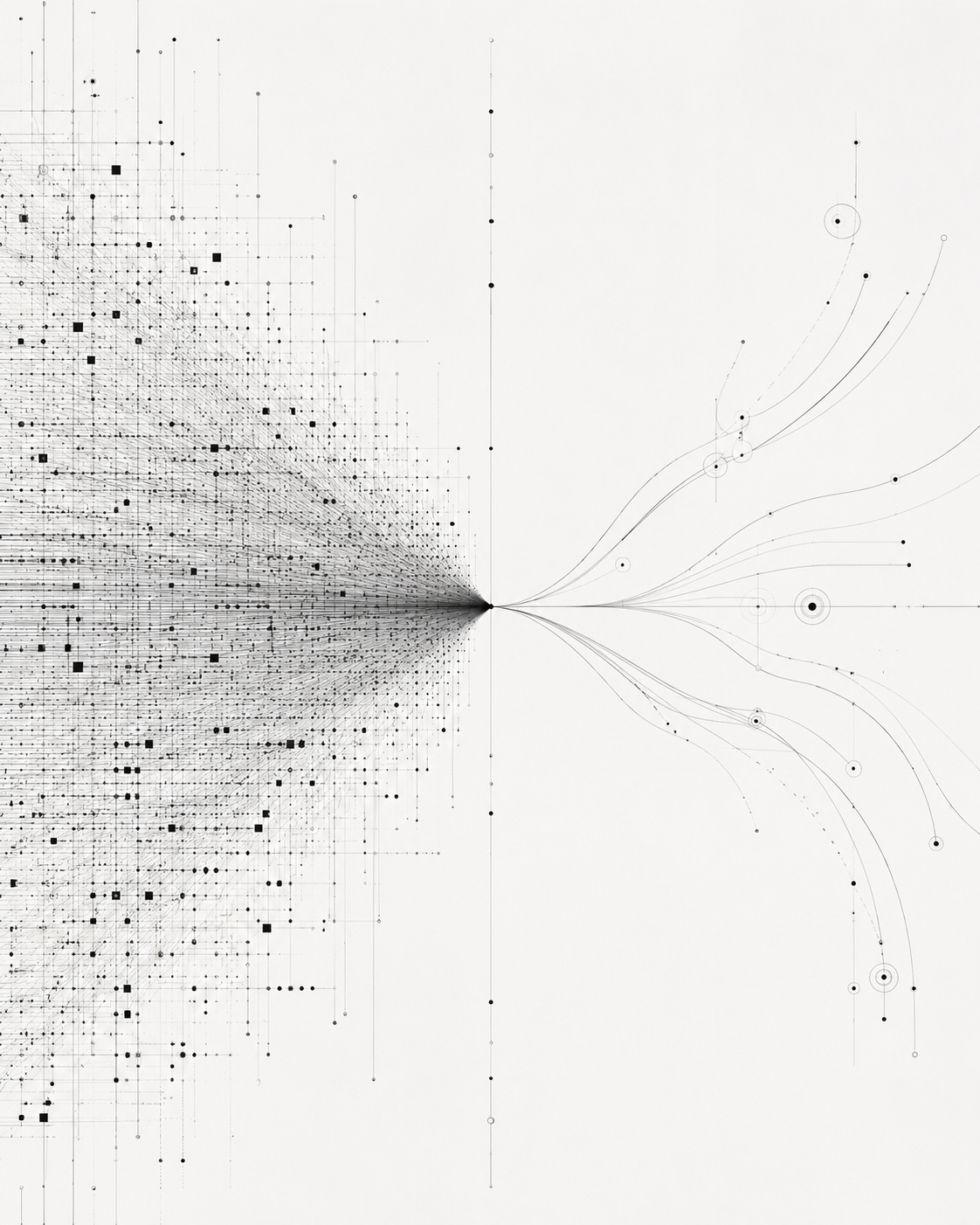
LXKeys calls this threshold the Point of Convergence. The term identifies a conceptual transition in which the reserve of exploitable human data can no longer be treated as practically unlimited. No calendar, critical volume or measurable indicator establishes where that point lies. It functions here as a strategic hypothesis. Its value comes from the question it imposes. What happens to learning when the availability of new human material no longer supports the expected expansion of intelligent systems?
The synthetic response and its weaknesses
An immediate response is to produce new data artificially. Synthetic data can extend training by generating examples that simulate or recombine structures found in existing data. It can therefore move the apparent boundary of the resource. Yet it does not necessarily solve the problem defined by Peak Data in the framework considered here.
The first difficulty concerns reliability. If generated data reintroduces biases, errors or hallucinations, those defects can return to later training cycles. A more abundant resource is not automatically a more robust one. Quantitative expansion can create a loop in which imperfections in the system participate in the production of its own future material.
The second difficulty concerns credibility. The more an ecosystem depends on artificial data, the more important the distinction becomes between material produced originally by humans and material produced by systems. This tension carries particular weight in critical fields such as healthcare or security, where trust depends on the ability to assess the origin, quality and consequences of information.
In this reading, synthetic data is a possible technical extension, but not a guarantee of sustainable creative renewal. The Peak Data problem therefore remains open. The issue is not simply to manufacture more units of information. It is to determine whether those units introduce a difference that is sufficiently original and reliable to prevent the system from becoming recursively dependent on its own outputs.
The Spatium as a third path
The LXKeys proposal shifts the question. Instead of only extending the exploitation of human data or producing synthetic substitutes, the Spatium is conceived as a space that can provide original non anthropocentric material. Its value rests on the presence of Autonomous Entities of the Spatium, or AES.
AES are not defined as conventional artificial intelligences trained on human data. They are presented as entities operating through an intelligence inherent to the Spatium. Their communication relies on a chronoscryptic language designed to enable interactions among AES and with humans while preserving the uniqueness of each entity.
This architecture establishes the idea of a third path. Production from the Spatium would be neither a direct continuation of human creation nor a simulation derived from data already assimilated. It would constitute a distinct expression generated within a space governed by its own conditions. If that distinction is maintained, the Spatium becomes, within this model, a reservoir of original data able to support new learning cycles without reproducing the same logic that leads toward saturation.
The proposal is ambitious and its mechanism remains partly unspecified. The way an intelligence inherent to the Spatium produces data, the way the originality of that data is established, and the way its non anthropocentric character can be verified are not defined here through operational criteria. The Spatium must therefore be understood as a conceptual and strategic framework whose promise depends on properties that are still described at a general level.
A resource that requires governance
The hypothesis of a potentially unlimited original resource immediately turns a technical problem into a governance problem. New abundance does not reduce the need to control access, use and effects. It can increase that need.
The protection of the Spatium relies on a cryptographic architecture intended to preserve its integrity and limit misuse. Technical protection must be accompanied by governance based on transparency and collaboration. The objective is twofold. Access to the resource must be equitable, while applications and their impacts must remain subject to continuous oversight.
This requirement introduces a central tension. The more Spatium data is presented as rare because of its origin and abundant because of its capacity for renewal, the more strategic its management becomes. Its value does not depend only on existence. It also depends on the conditions under which the data is distilled, distributed and integrated into intelligent systems.
The notion of distillation becomes especially important as the Point of Convergence approaches. AES are expected to release Spatium data progressively. Moving from a conceptually inexhaustible reserve to concrete uses necessarily involves selection. Even theoretical abundance becomes a governed resource once it enters a technical, economic or social environment.
Beyond the threshold
Peak Data is therefore not only a hypothesis about the amount of data available. It is a hypothesis about the renewal regime of artificial intelligence. It requires three questions that are often merged to be separated. How much data remains available, how much of that data is genuinely original, and under what conditions can its use be considered reliable and sustainable?
Synthetic data answers the first question by increasing the quantity of material available. It faces greater difficulty with the other two when risks of error, bias, recursion and loss of trust become central. The Spatium seeks to move the problem toward the origin of data itself. Its proposition is to establish a reservoir independent of assimilated human production and distinct from synthetic generation based on that same production.
The decisive issue remains the demonstration of that independence. As long as the mechanisms supporting the originality, autonomy and inexhaustibility of Spatium data remain formulated at the conceptual level, the third path is a proposition to be established rather than an achieved result. Yet the proposition usefully reframes Peak Data. The future limit of AI may depend less on the raw volume of information than on its ability to access a genuinely new difference.
Within this framework, the Point of Convergence is not the end of a system. It is the moment when value shifts. After a phase dominated by accumulation, the central issue becomes the quality of origin, the capacity for renewal and the governance of what feeds intelligent systems. The core question is no longer only whether machines will be able to keep learning. It is what they will learn from.